This is the GNOXIC nexus
where one little current of gnosis
crosses many streams of semiosis
here in the backwoods of Manitoulin Island, Canada.
Mail: gnox -at- gnusystems (dot) ca.
Technical note: All gnoxic pages are designed to display white or light-colored text on a black background. Why? Mainly because i find it much easier on the eyes, for those who actually read the text onscreen (see below for more). It might even help to conserve energy (see the Blackle search site.)
GNOX is an OS whose current human embodiment is Gary Fuhrman of Manitoulin Island, Canada, who maintains this site.
| Turning Signs |
The book i've been working on since the 21st Century began was published as online netbook (6 September 2015) and is still being updated along with the Turning Signs blog. Read more about it there. |
| SourceNet |
This is an organized, indexed and annotated listing of the most important resources used in the research that went into Turning Signs. There's also a master reference list for all my published work. |
| C. S. Peirce |
I've devoted several pages here to the philosopher who has influenced my work most deeply. Some of these pages may be of use to other students of Peirce. |
| gnusystems |
The gnusystems home page includes resource listings and links related to the transition to a more sustainable and resilient human presence on earth, especially as it applies to Manitoulin Island. |
| other publications |
Most recent peer-reviewed publication: ‘Peirce’s Retrospectives on his Phenomenological Quest,’ Transactions of the Charles S. Peirce Society Vol. 49, No. 4, pp. 490-508, ©2013. See below for links to earlier publications.
|
| Eihei Dogen |
I've been studying the works of this Japanese Zen master (1200-1253) for some time. His Shobogenzo (‘Treasury of the True Dharma Eye’) is a collection of his ‘dharma talks’, some of which are available either in print or online in several English translations, listed here to facilitate comparing different translations of the same talk. The most famous is GenjoKoan (1233), and 8 different translations are interlinked here for systematic comparison. |
| Eugene Gendlin |
Gendlin's ‘Thinking Beyond Patterns: Body, Language and Situations’ (1992), reproduced here in full, greatly influenced the early stages of my inquiry. |
| Leaves of Grass |
by Walt Whitman: this webpage edition corrects some formatting and proofreading errors in the text version which i did years ago for Project Gutenberg. |
in open-access online journals:
- Rehabilitating Information, slightly reformatted version of a paper published February 2010 in Entropy.
- ‘The Cosmic Bellows: The Big Bang and the Second Law’ (with lead author Stanley N. Salthe) in Cosmos and History: The Journal of Natural and Social Philosophy, vol. 1, no. 2, 2005. Abstract with link to full text at www.cosmosandhistory.org.
- Methods, maps and transformations: review article on Velmans (2000), Investigating Phenomenal Consciousness (Vol. 9 No. 2, 2002)
Book reviews
published in the Journal of Consciousness Studies [some of these are longer than the versions published in JCS]:
- Review of Søren Brier (2008), Cybersemiotics (Vol. 16 No. 1, January 2009)
- Review of Evan Thompson (2007),
Mind in Life: Biology, Phenomenology, and the Sciences of Mind (December 2007)
- Review of Christof Koch (2004),
The Quest for Consciousness: A Neurobiological Approach (Vol. 11 no. 5/6, 2004)
- Review of Terrace and Metcalfe (ed. 2005), The Missing Link in Cognition: Origins of Self-Reflective Consciousness (Vol. 13, No. 9, 2006)
- Review of Paul Bloom (2004),
Descartes' Baby (an abridged version of this was published in JCS Volume 11 no. 9, September 2004)
- Review of Schacter and Scarry (ed. 2002),
Memory, Brain and Belief (Vol. 10 no. 3, 2003)
- Review of Damasio, Harrington, Kagan, McEwen, Moss and Shaikh (ed. 2000), Unity of Knowledge: The Convergence of Natural and Human Science (Vol. 9 no. 8, 2002)
- Review of Manfred Spitzer (1999),
The Mind Within the Net (Vol. 8 no. 4, 2001)
- Review of Jerome Kagan (2002), Surprise, Uncertainty and Mental Structures (Vol. 10 no. 3, 2003)
- Review of Seán Ó Nualláin (2002),
The Search for Mind: A New Foundation for Cognitive Science (Vol. 11 no. 2, 2004)
Why gnoxic?
The OS gnox has been using Gary Fuhrman as a vehicle on the Net since the late 1980s. The name may allude to gnosis (Greek γνωσις), which originally meant inquiry, knowledge, recognition or acquaintance, but in more recent usage represents the intuitive, mystical, private or esoteric side of ‘knowing’ in contrast to the more public and scientific side. Gnoxic studies aim in part to show that ‘gnosis’ and science are in fact two sides of the same coign, so to speak. If you'll pardon the pun, the x is crucial: it symbolizes the crossing of paths at the heart of genuine dialogue. It's also a reminder that inquiry, or dialog (see Chapter 2 of Turning Signs) is always exploratory.
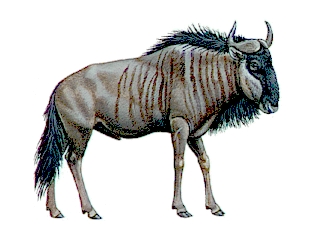 Since 2000, Gary has also been half of a partnership with Pam Jackson called gnusystems. ‘Gary Gnu’ was a character in an old TV show for kids, and gnu became a family nickname for the domestic side of gnox—which is a reversal of sorts, since the gnu (also called wildebeest) is a kind of wild ox.
This ox also appears in Buddhist scripture, for instance in the third chapter of the Lotus Sutra and the famous series of ‘oxherding pictures’ published in several popular anthologies of Zen literature. Gnoxic studies entail finding and taming such an ox, but also releasing the wild truth dwelling within the domestic realm of words and other symbols. The instructions given by Dogen to a couple of newly appointed officials at his monastery are appropriate here:
Becoming oxen you need to pull the plow and the till; becoming horses you need to bite the reins and wear a saddle. Putting on fur, crowned with horns, swinging the tail, and shaking the head, kick over the barrier and enter straight through the dragon gate. Without seeking to become sages, be people who are capable of your duties. Without valuing personal spiritual development, be the host within the guest.— Dogen, Eihei Koroku 2.139 (Leighton and Okumura 2004, 168)
Ox is also the meaning of aleph, the first letter of the Hebrew alphabet. And since it is silent (like the first letter of gnox), i will refrain from mentioning the Kabbalistic significance of this fact. As for the gn, its root is the proto-Indo-European gn- or gen-, which has many generations of descendants in many languages (including gnosis and nature); for a family tree, see Bishop (1986), pp. 186-7.
Why is this text white on black?
I've often spent several hours at a time reading from a computer screen, which is apt to give me a headache if i am forced to read text on a white background. Black ink on white paper is perfectly natural and sensible for printed books, because the contrast makes the text stand out in the light reflected from the page. But computer screens generate their own light and shine it at the reader. What should be shining at the reader is the text, not the background! Taking the color scheme appropriate for printed books and habitually transferring it to computer screens, while ignoring the obvious difference between these media, is an example of what typically happens when old conventions collide with common sense: the user loses. So i try to save my reader's eyesight by using CSS to make my pages white on black. If you really prefer the reverse, you can probably change the settings in your browser to make them display dark text on a bright background.